
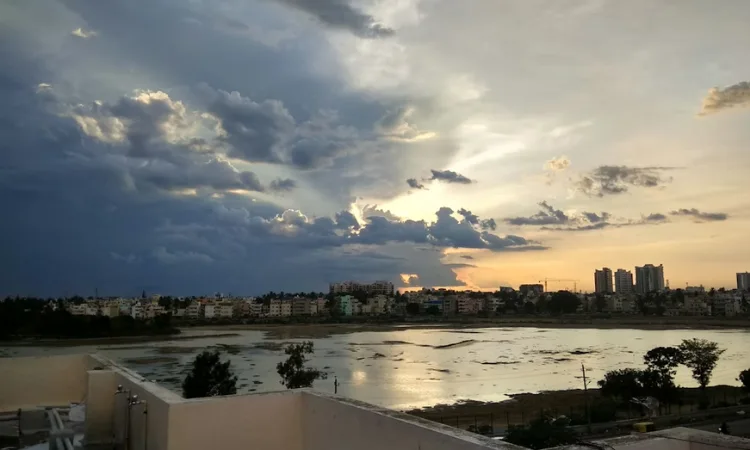
Quick answer: Bangalore has 213 lakes as of 2025 — down from 280+ in the 1960s due to rapid urbanisation, but actively being restored. The largest lake is Bellandur (892 acres, but severely polluted). Best for boating: Ulsoor Lake (entry ₹25, near MG Road). Best for birdwatching: Hebbal Lake (free entry). Best for morning walks: Sankey Tank (opens 6 AM) and Agara Lake (HSR Layout). Most beautifully restored: Kaikondrahalli Lake (Sarjapur area).
Long before Bangalore became India’s Silicon Valley, it was known as a city of lakes. The Kempegowda kings and later Mysore rulers built a remarkable network of interconnected tanks and water bodies that served as the city’s water supply, irrigation system, and ecological backbone for centuries. At its peak in the 1930s, Bangalore had over 280 lakes within its boundaries.
Today, 213 lakes remain — and the good news is that many have been beautifully restored through community-driven conservation efforts. Walking by one of Bangalore’s lakes at dawn, with mist on the water and birds calling from the reeds, is one of the city’s most underrated experiences. This guide covers the lakes worth visiting, what to do there, and what to know before you go.
Best Lakes in Bangalore — Detailed Guide
1. Ulsoor Lake (Halasuru Lake) — 123 Acres, Central Bangalore

Ulsoor Lake is the most accessible and popular lake in central Bangalore, located just 2 km from MG Road in the Halasuru neighbourhood. The lake dates to the Kempegowda era and was later expanded by Commissioner Lewin Bentham Bowring. Spanning 123 acres, it is one of the largest urban lakes in Bangalore and the most visited.
The main draw is boating — the Maurya Sankey Boat Club at Ulsoor operates pedal boats, rowboats, and motorboats on the lake. The island in the middle is accessible by paddle boat and has a small play area. Around the lake, a well-maintained walking path winds through trees and gardens that attract morning walkers, joggers, and photographers. The lake is particularly beautiful at sunset.
- Size: 123 acres with small islands
- Entry fee: ₹25 for adults after 8 AM; children under 12 free
- Timings: 6 AM to 8 PM (closed Wednesdays)
- Boating: 10 AM to 6:30 PM — pedal boats, rowboats, motorboats
- Activities: Boating, morning walk, birdwatching, photography
- Location: Ulsoor, Bangalore — 2 km from MG Road, near Trinity Metro Station
Insider tip: The best time to visit Ulsoor Lake is between 6 AM and 7:30 AM on weekdays, before the crowds arrive. The morning mist on the water, combined with the calls of egrets and cormorants, creates a genuinely peaceful moment in the middle of a city of 12 million people. Avoid Sunday afternoons — the boating area becomes very crowded.
2. Sankey Tank — Built in 1882, Sadashivanagar

Sankey Tank is among the most beautiful and historically significant lakes in Bangalore. Built in 1882 by Col. Richard Hieram Sankey, the Chief Engineer of Mysore, as a safeguard against the city’s water supply droughts, the lake was also known as Gandhadhakoti Kere (named after a nearby Government Sandalwood Depot). It is connected to the historic Miller’s Tank and Dharmambudhi Tank system.
Located in the upscale Sadashivanagar and Malleshwaram area, Sankey Tank is a joggers’ paradise. The well-maintained track around the lake draws hundreds of regular walkers every morning. The lake is also home to a swimming pool and a plant nursery managed by the Forest Department. Sunsets at Sankey Tank are among the most photographed in the city.
- Size: Approximately 35 acres
- Entry fee: ₹10 per adult, ₹5 for children
- Timings: 6 AM to 8 PM (closed Fridays)
- Boating: ₹10–₹20 per person; 6 AM to 10 AM and 12 PM to 5 PM
- Special features: Swimming pool, plant nursery, island accessible by boat
- Location: Kodandarampura, near Malleshwaram and Sadashivanagar
Sankey Tank is close to Mantri Square Mall (Sampige Road metro). Read our Shopping Malls in Bangalore guide to combine a morning lake walk with a mall visit.
3. Hebbal Lake — 150 Acres, North Bangalore

Hebbal Lake is one of the three water bodies created by Kempe Gowda II, the founder of Bangalore, in 1537 — making it nearly 490 years old. Located at the junction of National Highway 7 and the Outer Ring Road, Hebbal Lake is the premier birdwatching destination in Bangalore, drawing migratory visitors from as far as Eastern Europe and Central Asia between October and February.
The lake attracts species including spot-billed pelicans, Eurasian spoonbills, Indian spot-billed ducks, sandpipers, purple herons, and grey herons. November and December are the peak months, when the lake transforms into a vibrant spectacle of nesting pelicans and wading herons. There is no entry fee, and the walking track around the lake is excellent for early morning fitness.
- Size: 150 acres
- Entry fee: Free
- Timings: 6:45 AM to 6:45 PM daily
- Best for: Birdwatching (Oct–Feb peak), sunrise photography, morning walks
- Migratory birds: Spot-billed pelicans, Eurasian spoonbills, purple herons, grey herons, sandpipers
- Location: Hebbal, North Bangalore — near NH7/Outer Ring Road junction
Insider tip: Arrive at Hebbal Lake at 6:45 AM with binoculars from October to February. The pelicans return to their nesting trees just after sunrise in large, dramatic formations. This is one of the best free wildlife spectacles in any Indian city.
4. Agara Lake — 98 Acres, HSR Layout

Agara Lake is a 98-acre natural lake that has been beautifully maintained between Koramangala and HSR Layout in South Bangalore. It dates back to the 8th century and was historically part of the interconnected lake system fed from Madiwala Lake and draining into Bellandur Lake. The lake was seriously degraded by the early 2000s but has undergone significant restoration.
Today, Agara Lake has a well-maintained jogging and cycling track that is extremely popular with HSR Layout and Koramangala residents. The track is wider than most lake tracks in the city, making it comfortable for both runners and cyclists. Birdwatching is also rewarding here — the lake attracts kingfishers, herons, and various duck species.
- Size: 98 acres
- Entry fee: Free
- Timings: 6 AM to 7 PM
- Best for: Jogging, cycling, birdwatching — best track in South Bangalore
- Location: Between Koramangala and HSR Layout, near Agara Lake Road
5. Kaikondrahalli Lake — 48 Acres, Sarjapur Road Area

Kaikondrahalli Lake is widely regarded as the best example of community-driven lake restoration in Bangalore. Once a dump yard in a neglected corner of Sarjapur Road, it was transformed through the extraordinary efforts of residents, environmentalists, and the BBMP into one of the city’s most carefully maintained urban ecosystems.
The 48-acre lake now supports over 100 bird species, has a children’s play area, a well-designed walking trail, and sitting benches for birdwatchers. It is the lake that best demonstrates what Bangalore’s urban lakes can be when properly maintained. The community actively monitors the ecosystem and resists encroachment.
- Size: 48 acres
- Entry fee: Free
- Best for: Birdwatching, nature photography, peaceful morning walks
- Location: Kaikondrahalli Lake Trail, Sarjapur Road area
6. Lalbagh Lake — Inside Lalbagh Botanical Garden

Lalbagh Lake sits inside the famous Lalbagh Botanical Garden, which was established by Hyder Ali in 1760 and later developed by the British. The lake itself was commissioned in 1890 by Superintendent James Cameron to supply water to the botanical garden. Today it is a peaceful centrepiece of the garden, surrounded by ancient trees and a remarkable diversity of birds.
The lake is accessible only by purchasing a Lalbagh entry ticket (₹20 per adult). For those who combine a lake visit with the garden’s incredible collection of tropical plants and trees — including a 3,000-year-old fossil tree — it is one of the best ₹20 experiences in Bangalore.
- Entry fee: ₹20 (includes garden entry)
- Timings: 6 AM to 7 PM daily
- Best combined with: Lalbagh Glass House, ancient tree walk, flower shows (January and August)
- Location: Lalbagh Botanical Garden, Basavanagudi
Lakes in Bangalore Under Threat — The Urbanisation Challenge
Bangalore had over 280 lakes in the 1960s. By 2007, urbanisation had destroyed or encroached upon so many that only 93 remained. As of 2025, 213 lakes exist under administrative protection — but many face ongoing challenges of sewage inflow, encroachment, and pollution from construction runoff.
Bellandur Lake — the city’s largest at 892 acres — became internationally notorious when its surface caught fire in 2015 and 2017 due to accumulated pollutants and toxic foam. The foam was so thick that it overflowed onto the Outer Ring Road. Varthur Lake faces similar challenges. These are cautionary tales of what happens when a city’s lakes are treated as wastelands rather than ecological assets.
The encouraging counter-story is lakes like Kaikondrahalli, Agara, and Puttenahalli, where resident-driven lake bodies have fought and won preservation battles, restored biodiversity, and created genuinely beautiful green spaces. These community victories are what give Bangalore’s lake conservation movement its momentum.
Related Guides: Top Hill Stations Near Bangalore | Best Places to Visit in Bangalore With Family on Sunday
Frequently Asked Questions — Lakes in Bangalore
Q1: How many lakes are in Bangalore?
Bangalore has 213 lakes as of 2025, managed by BBMP, BDA, the Forest Department, and BMRCL. This is down from over 280 in the 1960s — rapid urbanisation destroyed many lakes. Active conservation efforts have stabilised the count and restored several lakes to ecological health.
Q2: Which is the largest lake in Bangalore?
Bellandur Lake is the largest at approximately 892 acres, followed by Varthur Lake (180 acres). However, both are severely polluted. For a clean, accessible experience, Ulsoor Lake (123 acres) near MG Road or Hebbal Lake (150 acres) in North Bangalore are the recommended options.
Q3: Which lake in Bangalore is best for boating?
Ulsoor Lake near MG Road — the Maurya Sankey Boat Club offers pedal boats, rowboats, and motorboats. Entry: ₹25 for adults, free for children under 12. Sankey Tank also has boating at ₹10–₹20 per person.
Q4: Which Bangalore lake is best for birdwatching?
Hebbal Lake (North Bangalore) is the best for migratory birdwatching, especially October to February when spot-billed pelicans, Eurasian spoonbills, and purple herons arrive. Kaikondrahalli Lake (Sarjapur area) and Agara Lake (HSR Layout) are also excellent. All three are free entry.
Q5: When was Sankey Tank built?
Sankey Tank was built in 1882 by Col. Richard Hieram Sankey, Chief Engineer of Mysore, as a drought safeguard for Bangalore’s water supply. It is also known as Gandhadhakoti Kere. Entry: ₹10 adults, closed Fridays.
Q6: Which is the best lake for morning walks in Bangalore?
Sankey Tank (Sadashivanagar, opens 6 AM) has the most famous morning walk track. Agara Lake (HSR Layout) has the widest and best-maintained jogging and cycling track in South Bangalore. Kaikondrahalli Lake (Sarjapur) has a beautifully restored trail through natural habitat.

