
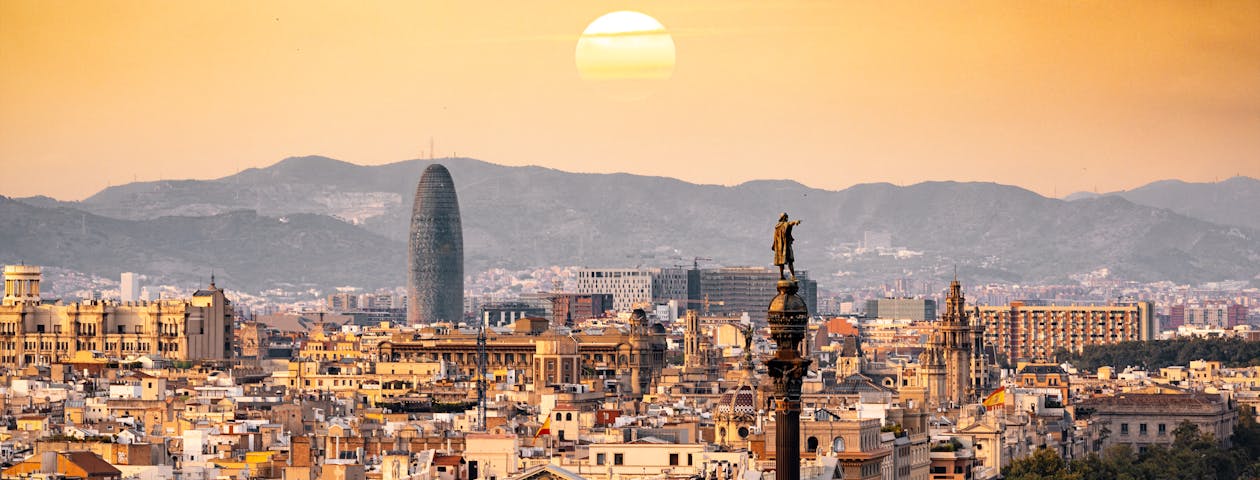
Old Bangalore vs. New Bangalore:
Photos That'll Break Your Heart
"The city hasn't changed — it's just become unrecognisable." — every old Bangalorean, every single year.
There is a grief only Bangaloreans know. It arrives quietly — when you see an old photo of MG Road lined with trees, or Cubbon Park on a Sunday so silent you could hear your own thoughts. Bengaluru has undergone one of Asia's most dramatic urban transformations in just five decades. From the Garden City to the Silicon Valley of India — and these before-and-after stories will make you feel every kilometre of that journey.
Whether you grew up here in the 1970s or arrived last year chasing a startup dream, this is the story of the city you both love and barely recognise. Let's walk through it together.
In This Article
Cubbon Park — Then vs Now
Established in 1870 by British engineer Richard Sankey, Cubbon Park was once so quiet that Sunday morning visitors could hear birdsong from 100 metres inside the gate. Today it is the lung of a 13-million-person city — surrounded by six-lane roads on every side, yet somehow still standing.

Sprawling lawns, horse carriages, and absolute silence. Bangalore's living room — open to everyone regardless of class.
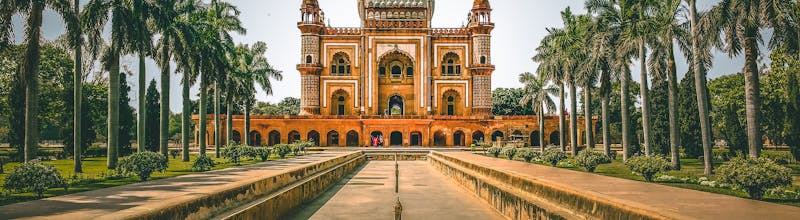
Flanked by flyovers, honking traffic, and a Metro station — yet still green, still beautiful, still packed every morning at 6 AM.
📌 Did You Know? Cubbon Park covers 300 acres and is home to 96 tree species. Despite the city growing tenfold around it, the park's boundaries have remained almost unchanged since the British era. It's one of the last places in Bengaluru where you can still hear silence.
MG Road — The Road That Lost Its Trees
In the 1960s, Mahatma Gandhi Road was the most beautiful boulevard in South India. Fully canopied, lined with rain trees and jacarandas, it was a road people came to simply walk — not to get somewhere, but to be somewhere. Couples strolled. Elderly men read newspapers. The light filtered through leaves like something from a painting.
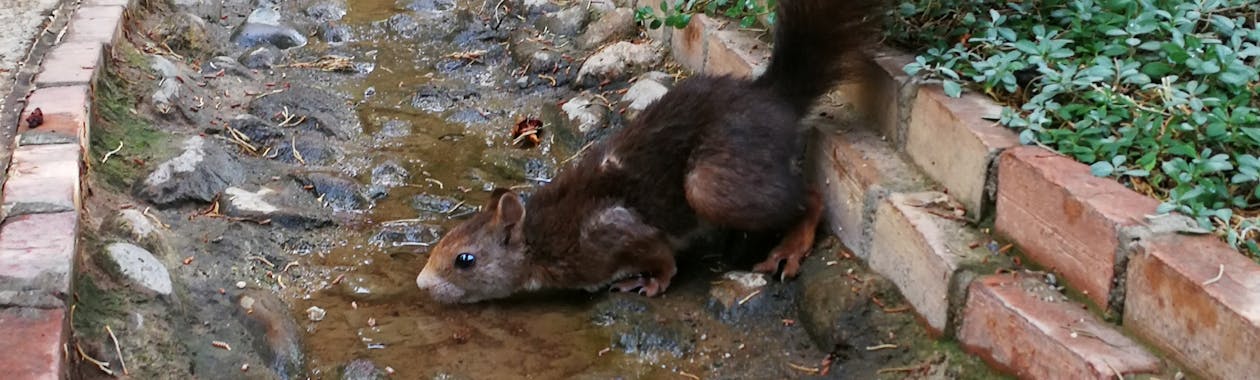
Modern Bangalore roads — infrastructure built for speed, not for people.
Today MG Road is flanked by malls, pubs, and the Namma Metro Green Line rumbling overhead. The trees are largely gone. The benches are gone. But the road still pulses — and in a way, it still tells Bangalore's entire story: old beauty, new hustle, and an unsettled question about what was worth keeping. You can read more about how this transformation fits into the broader story of why Bangalore became India's Silicon City.
Vidhana Soudha — The One Constant
Not everything changed. Vidhana Soudha, built in 1956 and housing Karnataka's state legislature, is proof that some things in Bangalore are built to outlast everything around them. When it was completed, it stood alone on the skyline — a granite giant visible from miles across open land. Today it is surrounded by city chaos, yet on Sunday evenings when the floodlights ignite its facade, the whole of Bangalore seems to pause.
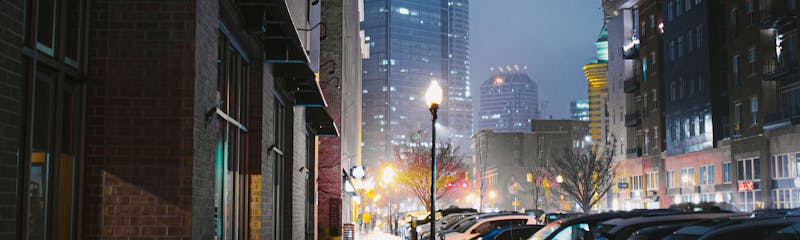
Stood alone on the skyline. A statement of post-independence ambition — visible from open farmland where tech parks now stand.

Surrounded by everything new Bangalore has become — yet still the most dignified building in the city, lit in gold every Sunday night.
"Government work is God's work."— Inscription on Vidhana Soudha, placed in 1956 by Chief Minister S. Nijalingappa. Still there.
Lalbagh — The Garden That Refused to Die
Lalbagh Botanical Garden is the most miraculous thing about modern Bangalore — not because it is beautiful (though it is), but because it survived. Founded in 1760 by Hyder Ali and expanded by his son Tipu Sultan, this 240-acre sanctuary sits in the dead centre of one of the most densely developed cities in Asia. It had every reason to be paved over. It wasn't. Old Bangalore residents speak of Lalbagh mornings the way some people talk about religion.
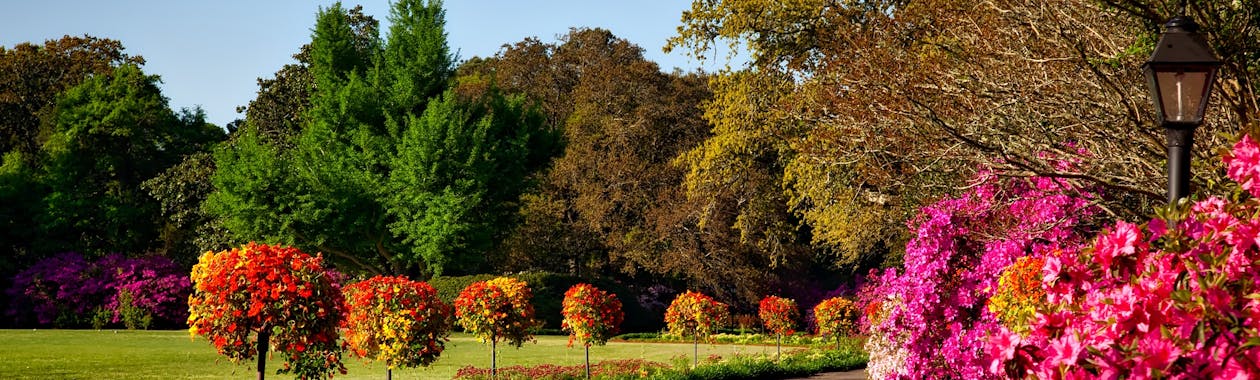
Lalbagh's century-old trees — some planted during the reign of Tipu Sultan, still standing in 2026.
If you are looking for where to stay in Bangalore and want that old-city feeling — quiet streets, old-growth trees, slow mornings — the neighbourhoods around Lalbagh (Jayanagar, Basavanagudi, Gandhinagar) still carry echoes of the original Bengaluru.
From Trams to Namma Metro
Old Bangalore had trams. Let that land for a moment. Trams that ran from Kalasipalya to Shivajinagar. Cycle rickshaws that moved at the pace of conversation. Double-decker buses that felt like an event. In 1985, a bullock cart carrying ISRO satellite equipment trundled down Bangalore's roads — that bizarre image became the symbol of how Bangalore became Silicon City: old world, new cargo, extraordinary ambition.
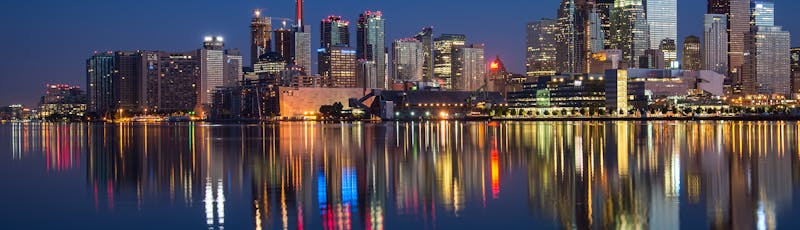
Trams, double-deckers, and cycle rickshaws. Traffic jams were measured in minutes, not hours. People knew their bus drivers by name.
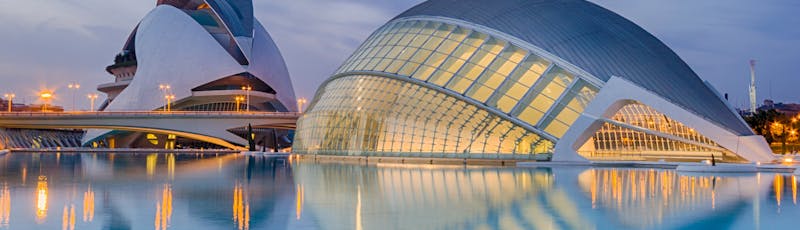
73+ km of Metro track, 61 stations — still not enough, but finally a city taking its traffic problem seriously. Even if 30 years late.
The traffic irony is real: Bangalore built a world-class Metro and the roads are still gridlocked. Because the city grew faster than any infrastructure could follow. But if you are planning life in the city today, knowing which area of Bangalore to stay in based on Metro access can save you two hours of your day.
Section 06Darshini vs. Cloud Kitchen — The Food Revolution
Old Bangalore's food culture was built on the darshini — the standing-counter Udupi restaurant where idli-vada-sambar cost ₹6, the service was under three minutes, and the uncle behind the counter knew your order before you opened your mouth. Meals were eaten standing up, in silence or in conversation, and left you full for ₹12. It was one of the great dining formats in human history.

Idli-vada for ₹6. No tables, no menus, no apps. Family recipes that hadn't changed in 40 years. Regulars who felt like family.

Minimum order ₹200. 30-min delivery. Aesthetic plating for Instagram. 50 menu items, zero regulars. Ghost kitchen somewhere in an industrial park.
But — and this is the miracle — the darshinis never disappeared. They adapted. They added takeaway boxes and UPI QR codes and they are still there, still serving the same idlis. The best vegetarian thali restaurants in Bangalore still serve the most honest food in the city for under ₹100 a plate. New Bangalore didn't replace old Bangalore's food. It just layered on top of it.
And on the other end of the spectrum — for special evenings — the city has built some extraordinary new experiences too. See our guide to the best candle light dinner spots in Bangalore for how romance has transformed in the new city.
Section 07Chickpete vs. Whitefield — Two Cities, One PIN
Perhaps the sharpest way to understand old vs new Bangalore is to stand in Chickpete at 8 AM — narrow lanes, jasmine garlands, temple bells, silk merchants — and then take a cab to Whitefield, 45 minutes away (on a good day). You will feel like you have crossed a national border. Same city. Different century.

Temples every 100 metres. Silk shops unchanged in 40 years. Morning flower markets. Red-oxide floors and wooden column architecture. Bangalore as it was born.
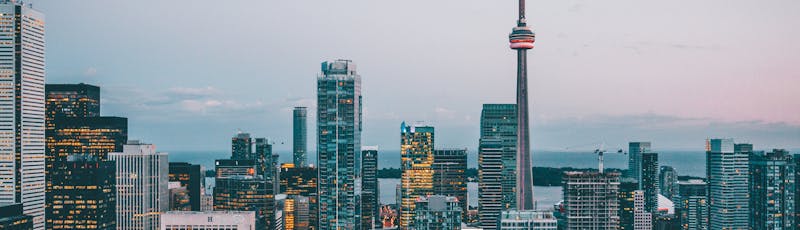
Glass towers, co-working spaces, international schools, brunch menus in 8 languages. A neighbourhood that didn't meaningfully exist in 1995.
Whitefield was a quiet Anglo-Indian settlement until the late 1990s. Then IT happened. Today its population exceeds one million. It has its own micro-economy, its own culture, its own traffic patterns — and its own identity almost entirely separate from the rest of Bangalore. Picking the right area to live depends entirely on which of these two Bangalores you want to be part of. Our area-by-area guide to staying in Bangalore breaks this down clearly. If you are a student arriving in the city, the best PG options in Bangalore vary dramatically between old city and new tech corridors.
Hyder Ali founds Lalbagh. Bangalore is a quiet Mysore Kingdom military outpost. Population: a few thousand.
British era. Cubbon Park, MG Road, and the cantonment bungalow belt take shape. Bangalore becomes a "pensioner's paradise."
HAL, ISRO, BHEL, BEL establish massive campuses. Bangalore becomes a public sector city. Population doubles. Trees still standing.
Economic liberalisation ignites the IT boom. Infosys, Wipro, Texas Instruments arrive. Electronic City is born. First traffic jams appear.
Startup culture explodes. City renamed Bengaluru in 2006. Flyovers replace trees. Lakes disappear. Population crosses 8 million.
Namma Metro opens. Unicorn startups emerge. Population crosses 13 million. Heritage movements begin. The city finally asks: what did we give up?
What We Gained. What We Lost.
It would be dishonest to call Bangalore's transformation only a loss. The same city that cut down its trees also created millions of jobs and became the engine of modern India's knowledge economy. The tragedy is not that Bangalore changed — every great city does. The tragedy is how much of what was lost didn't have to be.
💔 What Old Bangalore Lost
- Over 16,000 lakes — now under 200
- The tree canopy over inner-city roads
- A genuinely walkable city centre
- The quiet. The actual quiet.
- Affordable living for the middle class
- Old bungalow neighbourhoods
- The sense of a city that knew itself
🌱 What New Bangalore Gained
- 13 million jobs in the knowledge economy
- India's most active startup ecosystem
- World-class hospitals and colleges
- A cosmopolitan, multicultural identity
- Namma Metro (finally)
- A food scene that rivals any global city
- The ambition to keep improving
"Bangalore doesn't ask for your loyalty. It earns it — through the morning mist over Cubbon Park, through the silence of Lalbagh at dawn, through the way a stranger shares an umbrella at a bus stop during monsoon."— A long-time Bangalorean, 2025
Old Bangalore and New Bangalore are not opposites. They are the same city at different speeds. The heritage conservation movements, the lake revival campaigns, the urban forestry drives — they are the signs of a city finally slowing down enough to look at what it nearly threw away. And that, perhaps, is reason for hope.
Did this bring back memories? Share it with someone who loves Bangalore. 💚
Frequently Asked Questions
Is Old Bangalore Gone Forever?
Not entirely. It lives in Lalbagh at 6 AM. In the smell of filter coffee at an old Udupi hotel. In the quiet dignity of Basavanagudi. In the way auto drivers still argue about routes.
What's your favourite old Bangalore memory? 💬 Tell us in the comments below.