
Best Game Development Companies in India: 2026 Independent Review and Ranking
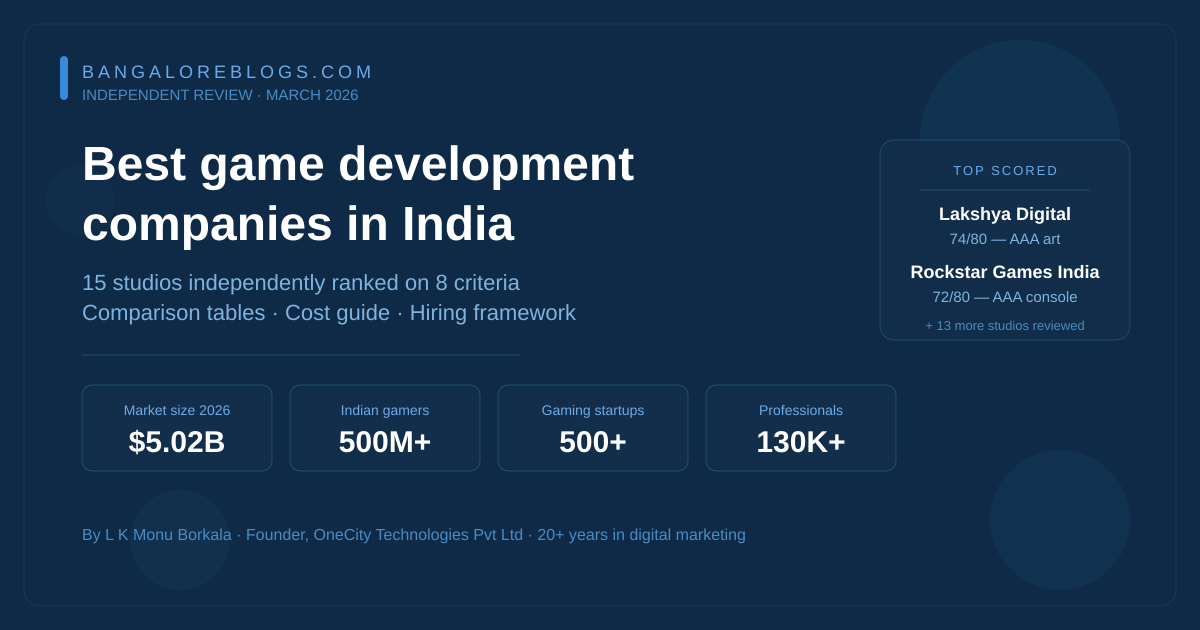
The best game development companies in India in 2026 include Lakshya Digital (AAA art, part of Keywords Studios), Nazara Technologies (India's most prominent listed gaming company), Juego Studios (full-cycle co-development), Moonfrog Labs (mobile-social games), and SuperGaming (original IP with MaskGun and Indus). This list features 15 studios independently evaluated across 8 criteria — from technical depth and platform coverage to post-launch support and innovation. India's gaming market is projected to hit $5 billion in 2026, and these companies represent the production backbone behind that growth.
What You'll Find in This Guide
- India's Gaming Industry in 2026 — The Numbers
- How We Evaluated These Companies
- Master Comparison Table
- 15 Company Profiles (Detailed Reviews)
- Category Winners — Best by Specialization
- How to Choose the Right Game Dev Partner
- Game Development Cost in India — Quick Reference
- City-Wise Gaming Ecosystem Summary
- Frequently Asked Questions
India's Gaming Industry in 2026 — The Numbers That Matter
I've been tracking Bangalore's tech scene since 2004 — the year I started OneCity Technologies from a small apartment with ₹35,000 in hand. Back then, "game development in India" meant a handful of outsourcing shops creating assets for foreign studios. What exists today is a completely different animal.
India's gaming market has grown at a pace that even the most optimistic projections from five years ago didn't predict. According to Mordor Intelligence, the market is projected to reach $5.02 billion in 2026 and grow to $9.89 billion by 2031, at a compound annual growth rate of 14.52%. Mobile gaming dominates with nearly 80% of revenue, which makes sense in a country where smartphone shipments hit 32 million units in Q1 2025 alone.
Sources: Mordor Intelligence, IMARC Group, Statista. Projected values are compound estimates.
But here's what most listicles won't tell you: the number of studios doesn't equal the number of good studios. Walk through Koramangala or JP Nagar in Bangalore and you'll find game dev shops operating from co-working spaces next to AI startups and ed-tech companies. Some are genuinely excellent. Others are glorified freelance teams with nice websites. The gap between the top tier and the rest is wider than people realize.
That's exactly why I put this list together. Not as someone selling game development services, but as someone who has spent two decades evaluating tech companies across India — and who has the benefit of being based in Bangalore, where most of the serious game development actually happens.
How We Evaluated These Companies
Every other "best game development companies" list I've seen online has the same problem: no one explains how they picked the companies. Some lists are clearly paid placements. Others are self-promotional — the company writing the list ranks itself at #1. (Yes, I'm looking at you, Juego Studios. You wrote a "Top 10" blog and put yourselves first. That's marketing, not journalism.)
Here's how I approached this differently.
Our 8-Point Evaluation Framework
Each company was scored across these criteria, each weighted equally on a 1–10 scale. Total possible score: 80.
1. Technical Depth & Engine Expertise: Verified proficiency with Unity, Unreal Engine, and/or proprietary tools. Assessed through portfolio analysis, job listings (which reveal actual tech stack), and credited work on shipped titles.
2. Platform Coverage: Ability to deliver across mobile, PC, console, web, and emerging platforms (VR/AR/Web3). Studios covering more platforms with demonstrated work score higher.
3. Project Complexity & Track Record: Number and quality of shipped titles. AAA credits, high-download mobile titles, or technically demanding projects (real-time multiplayer, open world, large-scale matchmaking) score highest.
4. Team Size & Scalability: Verified headcount (cross-referenced via LinkedIn, Tracxn, and company websites). Ability to scale during production-intensive phases without compromising quality.
5. Client Portfolio & References: Publicly verifiable clients. Named testimonials. Long-term partnerships with publishers or brands carry more weight than one-off projects.
6. Innovation & Emerging Tech: Investment in AR/VR, AI-driven game design, blockchain/Web3, cloud gaming, or original IP. Forward-looking studios that build proprietary tech or tools score higher.
7. Post-Launch Support & LiveOps: Demonstrated ability to run live games — content updates, analytics, retention optimization, community management, server operations.
8. Industry Recognition & Awards: Verified awards, media features, industry body memberships (NASSCOM, GDAI, IGDC), and acquisitions or investments from credible entities.

I cross-referenced data from company websites, LinkedIn company pages, Tracxn (for verified financials and headcount), Crunchbase, Glassdoor, the MCA (Ministry of Corporate Affairs) registry, app store listings, and credited game databases. Where data points conflicted — for example, a company claiming "300+ employees" on their website but showing 182 on Tracxn's MCA-verified records — I've noted the discrepancy.
Master Comparison Table — All 15 Companies at a Glance
| # | Company | HQ City | Founded | Team Size | Primary Engines | Platforms | Score /80 |
|---|---|---|---|---|---|---|---|
| 1 | Lakshya Digital | Gurugram | 2004 | 1,000+ | Unreal, Unity, Proprietary | Console, PC, Mobile | 74 |
| 2 | Nazara Technologies | Mumbai | 1999 | 800+ | Various (through subsidiaries) | Mobile, Esports, Web | 71 |
| 3 | Juego Studios | Bangalore | 2013 | 180–300* | Unity, Unreal | Mobile, PC, Console, VR/AR | 68 |
| 4 | Moonfrog Labs | Bangalore | 2013 | 150–250 | Unity, Custom | Mobile | 66 |
| 5 | SuperGaming | Pune | 2018 | 150+ | Proprietary, Unity | Mobile, PC | 65 |
| 6 | Rockstar Games India | Bangalore | 2019 (acq.) | 200+ (est.) | RAGE (proprietary) | Console, PC | 72 |
| 7 | Dream11 | Mumbai | 2008 | 1,000+ | Custom | Mobile, Web | 63 |
| 8 | Octro Inc | Delhi NCR | 2006 | 200+ | Unity, Custom | Mobile | 61 |
| 9 | Junglee Games | Bangalore | 2012 | 750+ | Custom, Unity | Mobile, Web | 62 |
| 10 | iXie Gaming | Bangalore | 2011 | 700+ | Unity, Unreal | All platforms | 64 |
| 11 | Kwalee India | Bangalore | 2011 (UK) | 350+ (global) | Unity | Mobile, PC, Console | 62 |
| 12 | 99Games | Udupi | 2008 | 60–80 | Unity | Mobile | 59 |
| 13 | Mayhem Studios | Bangalore | 2021 | 100+ | Unreal | Mobile, PC | 58 |
| 14 | nCore Games | Bangalore | 2019 | 50+ | Unity, Unreal | Mobile | 55 |
| 15 | Hyperlink InfoSystem | Ahmedabad | 2011 | 1,000+ | Unity, Unreal | Mobile, Web, AR/VR | 57 |
*Juego Studios claims 300+ employees on their website, but Tracxn's MCA-verified data shows 182 employees as of August 2025. I've listed both figures for transparency.
Detailed Company Reviews
1. Lakshya Digital — India's AAA Art Powerhouse
Best for: AAA Art & Animation OutsourcingIf you want to understand what "world-class" actually means in Indian game development, start with Lakshya. Founded in 2004 — the same year I started OneCity, incidentally — this studio grew from a 6-person basement operation in Gurugram into India's largest game art outsourcing company, now employing over 1,000 people across eight global locations.
What sets Lakshya apart isn't size. It's the credits list. This studio has contributed art and animation to over 175 AAA titles — names that any serious gamer would recognize: Elden Ring, Final Fantasy XVI, Street Fighter 6, Alan Wake II, Baldur's Gate 3, Forza Motorsport, Destiny 2, and Returnal. These aren't vanity mentions; Lakshya artists worked on character models, environment art, rigging, and animation for these titles as embedded partners in global production pipelines.
Acquired by Dublin-based Keywords Studios in 2014, Lakshya now operates as a key node in the world's largest game development services network. Their proprietary tool, SWAT, streamlines collaboration across geographically distributed teams.
Who should work with Lakshya: If you're a mid-to-large studio needing high-fidelity 3D art, character design, environment art, or animation at scale — and you need it integrated seamlessly into an existing pipeline — Lakshya is probably your best option in India. They're not the studio for a small indie team that needs end-to-end development on a tight budget. They're the studio for publishers and AAA developers who need production-grade art at competitive rates.
Score: 74/80
2. Nazara Technologies — India's Most Prominent Listed Gaming Company
Best for: Publishing, Esports & Gaming EcosystemNazara operates differently from every other company on this list. Rather than building individual games, they've assembled an entire gaming ecosystem through strategic acquisitions — NODWIN Gaming (esports), Kiddopia (gamified learning for kids), Sportskeeda (sports media), and Next Wave Multimedia (World Cricket Championship).
Listed on the NSE since 2021, Nazara is the closest thing India has to an Activision or EA — a holding company that controls multiple gaming verticals. Their strength isn't in pixel-level game development. It's in understanding the Indian gaming consumer at a macro level and building or acquiring the companies that serve them.
If you're looking for a development studio to build your game from scratch, Nazara isn't the right call. But if you're a publisher looking for distribution in India, an esports organizer seeking a partner, or an investor evaluating the gaming market — Nazara is unavoidable.
Score: 71/80
3. Juego Studios — Full-Cycle Co-Development Specialists
Best for: Full-Cycle Game Development & Co-DevelopmentJuego is one of the most visible game development companies in India right now — in large part because they've invested heavily in content marketing and SEO. (Their blog ranks for dozens of game-development keywords, and yes, they put themselves at #1 on their own "Top 10" list. I have to be honest about that.)
But visibility aside, Juego has real substance. Since 2013, they've delivered 500+ games and apps for clients including Disney, Sony, 20th Century Fox, and MPL. Their strength is in structured co-development: you bring the concept, they plug in developers, artists, and QA as an extension of your team. They work across Unity and Unreal, cover mobile, PC, console, and VR/AR, and have built a reputation for hitting timelines — which, in this industry, counts for a lot.
One caveat: there's a significant discrepancy in their reported team size. Their website says 300+ professionals. Tracxn's MCA-verified data from August 2025 shows 182 employees with revenue of ₹21.3 crore. Both could be partially correct if the larger number includes contractors, but it's worth clarifying before you commit to a large-scale engagement.
Score: 68/80
4. Moonfrog Labs — Mobile-Social Gaming DNA
Best for: Social & Casual Mobile GamesFounded by ex-Zynga engineers — and that pedigree shows in everything they build. Moonfrog Labs is probably the strongest mobile-first studio on this list when it comes to understanding Indian gaming audiences. Their flagship titles — Teen Patti Gold, Ludo Club, and Jalebi — aren't technically ambitious. But they're phenomenally well-designed for retention, social engagement, and monetization in the Indian market.
Backed by Sequoia Capital and Tiger Global, and later acquired by Sweden's Stillfront Group, Moonfrog has the kind of institutional support that most Indian gaming startups lack. They understand live operations, user acquisition, and retention loops at a level that comes from years of running games with millions of daily active users.
But here's the thing — if you're looking for a studio to build a console RPG or a visually stunning PC title, Moonfrog isn't your pick. They're mobile-social specialists, and that's where their DNA lives.
Score: 66/80
5. SuperGaming — India's Original IP Bet
Best for: Original IP & Multiplayer Mobile GamesSuperGaming is the most interesting company on this list from a pure ambition standpoint. While most Indian studios are content doing outsourcing or adapting established genres, SuperGaming is trying to build globally competitive original IP from India. MaskGun, their multiplayer FPS, has crossed 60 million downloads. Silly Royale brought social deduction to mobile audiences. And Indus — their Made-in-India battle royale — is their most ambitious bet yet.
What separates SuperGaming from the pack is their in-house technology platform for live game operations and player analytics. They're not just building games; they're building the infrastructure to run them at scale — and licensing that infrastructure to other developers.
Score: 65/80
6. Rockstar Games India — AAA Heritage
Best for: AAA Console & PC Game SupportWhen Rockstar Games acquired Dhruva Interactive for $7.9 million in 2019, it wasn't just a business deal. It was a validation of Indian game development talent at the highest level. Dhruva, one of India's earliest game development companies, had been doing serious console and PC work since the late 1990s — a time when virtually no one else in India was even thinking about games.
Now operating as Rockstar Games India, this Bangalore studio contributes to some of the biggest franchises in gaming history, including Grand Theft Auto and Red Dead Redemption. They don't take external clients or offer outsourcing — this is a captive studio serving Rockstar's internal needs. I've included them because understanding India's game development scene is incomplete without acknowledging that one of the world's most iconic game studios has a significant presence here.
Score: 72/80
7. Dream11 — Fantasy Sports Giant
Best for: Fantasy Sports & Real-Money Gaming PlatformsDream11 is a category of its own. With 220+ million registered users and the status of India's first gaming unicorn, Dream11 has redefined what "gaming" means in the Indian context. Their fantasy sports platform — spanning cricket, football, kabaddi, basketball, and hockey — has made them one of the most recognizable brands in Indian entertainment.
From a technology standpoint, the engineering challenge of running a real-time fantasy sports platform for hundreds of millions of users during peak cricket matches is as demanding as anything in traditional game development. Dream11's backend infrastructure, matchmaking systems, and real-time scoring engines are world-class.
They're not a game development studio in the traditional sense, but they've expanded into casual gaming and are increasingly relevant in discussions about India's gaming ecosystem.
Score: 63/80
8. Octro Inc — The Card Game Masters
Best for: Card Games & Social CasinoOctro has been quietly printing money from card and casino games since before most people were paying attention to Indian gaming. Their Teen Patti by Octro was one of India's earliest viral mobile games, and the portfolio has since expanded to poker, rummy, and blackjack with 3D avatars and social features. Combined downloads across their titles exceed 300 million.
They're not flashy. They don't write SEO blogs about being the "best game development company." But they've built a sustainable, profitable business in one of gaming's most reliable verticals — social card games with real-money elements. If that's your genre, Octro's depth of experience is hard to match.
Score: 61/80
9. Junglee Games — From San Francisco to Bangalore
Best for: Skill-Based & Real-Money GamingJunglee's acquisition by Flutter Entertainment Group (parent of FanDuel, Betfair, and PokerStars) tells you everything about where this company sits. With 750 employees and titles like Howzat Fantasy Cricket, Junglee Rummy, and Carrom Stars, they've built a portfolio that blends skill-based gaming with real-money mechanics — a sweet spot in the Indian market.
The Flutter backing gives them access to global gaming expertise and compliance frameworks that smaller Indian studios can't match, particularly important as India's regulatory environment for real-money gaming continues to evolve.
Score: 62/80
10. iXie Gaming — The Services Workhorse
Best for: Game QA, Testing & End-to-End ServicesiXie started life as a game testing company in 2011 and has since evolved into a full-service gaming operation with over 700 employees across eight international offices. They've touched more than 550 game titles across genres — which means they've seen more production pipelines, more technical challenges, and more edge cases than almost any other Indian studio.
Their QA and testing heritage actually makes them an unusually good development partner for studios that care about polish. Teams that grew up testing other people's games tend to build more robust products when they do their own development. iXie's strength is breadth and reliability, not glamour.
Score: 64/80
11. Kwalee India — Hyper-Casual at Global Scale
Best for: Hyper-Casual & Hybrid Casual Mobile GamesUK-headquartered Kwalee has one of the most impressive raw numbers in mobile gaming: over 700 million game downloads worldwide. Named Publisher of the Year at the TIGA Awards 2022 and recognized in the Top 50 Mobile Game Makers, Kwalee's Bangalore studio is a key part of their global production setup.
Their focus is hyper-casual and hybrid casual — games designed for massive reach, quick sessions, and ad monetization. If you're a publisher or brand looking for high-volume, quick-turnaround mobile games, Kwalee's Bangalore team has the production muscle and the data-driven publishing framework to deliver.
Score: 62/80
12. 99Games — The Udupi Surprise
Best for: Casual Mobile Games & Bollywood-Licensed TitlesHaving worked across Karnataka's tech ecosystem for two decades, I've been aware of 99Games since their early days in Udupi — a coastal town better known for its temples and restaurants than for game development. Founded by Rohith Bhat, 99Games proved that you don't need to be in Bangalore or Mumbai to build hit mobile games.
Their breakout title, Star Chef, and the Bollywood-licensed Dhoom:3 The Game, demonstrated a rare ability to blend original IP with culturally resonant licensed content. With 15+ game titles and 20 million+ installations, they've built a track record from a location that most people wouldn't associate with game development. That's exactly what makes their story compelling — global success from a tier-2 city.
Score: 59/80
13. Mayhem Studios — Bet on Battle Royale
Best for: AAA Mobile Battle RoyaleMayhem Studios is a bet. They're building Underworld Gang Wars — a battle royale game that draws from Indian locations and cultural themes — and they've got Lumikai's backing to do it. The game went into closed beta in 2024, and the early reception was mixed but promising.
I'm including them here because they represent the future of Indian game development: studios with original IP ambitions, serious funding, and the audacity to compete in a genre dominated by Krafton's BGMI and Garena's Free Fire. Whether they succeed or not, studios like Mayhem are the reason India's game dev industry is being taken seriously by global publishers.
Score: 58/80
14. nCore Games — Made-in-India Action
Best for: Indian IP Action GamesnCore gained national attention when they launched FAU-G (Fearless And United Guards) during the brief period when PUBG Mobile was banned in India. The game rode a wave of patriotic sentiment, though it received mixed reviews for gameplay quality. Since then, nCore has been iterating and expanding their portfolio, working on titles that lean into Indian themes and narratives.
They're still an early-stage studio finding their footing, but their ability to build cultural resonance into gaming — something that most Indian studios don't attempt — gives them a unique positioning. I'd watch this space.
Score: 55/80
15. Hyperlink InfoSystem — The Volume Player
Best for: Budget-Friendly Multi-Platform DevelopmentHyperlink is a different kind of company from the rest of this list. They're primarily an IT services firm that has a significant game development division — having delivered 140+ games alongside 4,500+ apps and 2,200+ websites for 2,700+ clients across 30 countries.
Their strength is volume and versatility. If you need a mid-tier mobile game built efficiently within a defined budget and timeline, Hyperlink can deliver. They're not going to win awards for artistic innovation, but they'll get the project done, on time, with competent execution. For many clients — especially those with clear specifications and limited budgets — that's exactly what's needed.
Score: 57/80
Category Winners — Best by Specialization
Not every studio is right for every project. Here's a quick reference for which company leads in each specialization.
| Category | Winner | Runner-Up |
|---|---|---|
| AAA Art & Animation | Lakshya Digital | Rockstar Games India |
| Full-Cycle Co-Development | Juego Studios | iXie Gaming |
| Mobile-Social Games | Moonfrog Labs | Octro Inc |
| Original IP | SuperGaming | Mayhem Studios |
| Fantasy Sports & RMG | Dream11 | Junglee Games |
| Hyper-Casual Publishing | Kwalee India | 99Games |
| Game QA & Testing | iXie Gaming | Juego Studios |
| Gaming Ecosystem / Publishing | Nazara Technologies | Dream11 |
| Budget-Friendly Development | Hyperlink InfoSystem | 99Games |
| Indian Cultural IP | nCore Games | SuperGaming |
How to Choose the Right Game Development Partner
After evaluating dozens of studios and speaking with founders, CTOs, and project managers across the Indian gaming ecosystem, here's what I'd tell anyone looking to hire a game development company in India.
Start with your platform, not with a company name. The studio that's perfect for your mobile casual game is almost certainly wrong for your PC multiplayer shooter. India's game dev ecosystem is specialized enough that platform-engine fit matters more than brand recognition.
Verify team size independently. I noticed significant discrepancies between claimed and verified employee counts across multiple companies. Check LinkedIn headcount, Tracxn data, or directly ask for MCA filings. A studio claiming 300 employees but actually staffing 180 may not be lying — contractors and freelancers often make up the difference — but you deserve to know how your team will actually be structured.
Ask for shipped titles, not portfolios. A beautiful concept art portfolio doesn't tell you whether a studio can manage scope, hit deadlines, and handle QA. Ask for links to games that are live in app stores right now. Check the reviews. Check the update frequency. A studio that ships regular updates to live games is telling you more about their operational maturity than any pitch deck.
Evaluate communication before you evaluate code. The number one complaint I hear from international clients working with Indian studios isn't about talent — it's about communication. Ask for a trial project or paid discovery phase before committing to a six-month engagement. See how the team handles feedback, documentation, and milestone reporting.
Look at what happens after launch. LiveOps — ongoing content updates, server management, analytics, community support — is where many studios fall short. If your game needs to be a live service, make LiveOps capabilities a non-negotiable part of your evaluation. Not every studio on this list can do it.
For a deeper dive into this topic, read our complete guide: How to Hire a Game Development Company in India.
Game Development Cost in India — Quick Reference
India offers 50–60% lower development costs compared to US or Western European studios. Here's a realistic cost breakdown by game type.
| Game Type | Cost Range (India) | Timeline | Team Size |
|---|---|---|---|
| Hyper-casual mobile | ₹3–10 lakhs ($3,500–$12,000) | 4–8 weeks | 3–5 |
| Casual/mid-core mobile | ₹15–60 lakhs ($18,000–$72,000) | 3–6 months | 5–12 |
| Multiplayer mobile (real-time) | ₹40–1.2 crore ($48,000–$144,000) | 6–12 months | 10–20 |
| PC/Console indie | ₹50–1.5 crore ($60,000–$180,000) | 8–18 months | 8–20 |
| AAA art outsourcing (per asset) | ₹5,000–50,000 per asset ($60–$600) | Varies | Varies |
| VR/AR experience | ₹20–80 lakhs ($24,000–$96,000) | 3–8 months | 5–15 |
| Fantasy sports platform | ₹80 lakhs–3 crore ($96,000–$360,000) | 6–12 months | 15–30 |
These are starting-point estimates based on conversations with multiple studios and publicly available pricing data. Actual costs depend on art quality requirements, multiplayer complexity, backend infrastructure, third-party integrations, and the studio's location tier. For a detailed breakdown, read our full guide: Game Development Cost in India 2026.
City-Wise Gaming Ecosystem Summary
India's game development talent isn't concentrated in one city. Here's a quick overview of where the action is.
Bangalore: The undisputed capital. Home to Rockstar Games India, Zynga India (500+ employees), Moonfrog Labs, Juego Studios, Junglee Games, Mayhem Studios, iXie Gaming, Kwalee India, and nCore Games. If you're evaluating Indian studios, start here. Read our full Bangalore guide →
Pune: Rising fast, anchored by SuperGaming and its original IP ambitions. Also home to Lakshya Digital's art studio and several indie teams. Read our full Pune guide →
Mumbai: Financial capital energy. Nazara Technologies and Dream11 are headquartered here, along with several real-money gaming platforms. Read our full Mumbai guide →
Gurugram / Delhi NCR: Lakshya Digital's headquarters and Octro's base. Strong in art production and card game development. Read our full Delhi NCR guide →
Hyderabad: Emerging hub with studios focusing on AR/VR and enterprise gamification. Read our full Hyderabad guide →
Chennai: Steady engineering talent with studios like ENA Game Studios (puzzle/escape room specialists) and Hammerplay Studios. Read our full Chennai guide →
For comprehensive industry statistics, read: India Gaming Industry Statistics 2026.
Frequently Asked Questions
- Which is the best game development company in India in 2026?
- It depends on your project type. Lakshya Digital leads for AAA art outsourcing. Nazara Technologies is the strongest for publishing and ecosystem plays. Juego Studios excels at full-cycle co-development. Moonfrog Labs is the top choice for mobile-social games. SuperGaming is the most ambitious original IP studio. The "best" company is the one that fits your specific platform, genre, budget, and engagement model.
- How much does game development cost in India?
- A basic hyper-casual mobile game costs ₹3–10 lakhs ($3,500–$12,000). Mid-core mobile games range from ₹15–60 lakhs ($18,000–$72,000). Full PC or console titles start at ₹50 lakhs and can exceed ₹5 crore for AAA-quality productions. India offers 50–60% lower rates than Western studios.
- Why is Bangalore considered India's gaming capital?
- Bangalore hosts the highest concentration of game studios in India — including Rockstar Games India, Zynga India (500+ staff), Moonfrog Labs, Juego Studios, Junglee Games, Mayhem Studios, and iXie Gaming. The city's tech talent pool, venture capital ecosystem, and startup culture create ideal conditions for game development.
- What game engines do Indian studios specialize in?
- Unity and Unreal Engine dominate. Unity is the standard for mobile and casual games. Unreal is used for AAA-quality visuals and console work. Some studios also use Cocos2d, Godot, and Phaser for specific project types. Studios like Lakshya Digital and Juego Studios maintain expertise across both major engines.
- Is it safe to outsource game development to India?
- Established studios follow international security standards — strict NDAs, isolated dev environments, VPN-secured connections, and controlled repository access. Lakshya Digital (Keywords Studios) and Rockstar Games India work with unreleased AAA IPs, demonstrating that security at the highest level is achievable. However, practices vary significantly, so verify a studio's specific protocols before engagement.
- How big is the gaming market in India?
- Projected at $5.02 billion in 2026, growing to $9.89 billion by 2031. India has 500+ million gamers, over 130,000 gaming professionals, and 500+ gaming startups launched in recent years. Mobile gaming accounts for nearly 80% of revenue.
- Which Indian game studio has worked on AAA titles?
- Lakshya Digital has contributed to 175+ AAA titles including Elden Ring, Final Fantasy XVI, Street Fighter 6, Baldur's Gate 3, and Forza Motorsport. Rockstar Games India contributes to the GTA and Red Dead Redemption franchises. These are co-development and art outsourcing credits.
- What types of games do Indian companies develop?
- The full spectrum: hyper-casual mobile, social card games, fantasy sports, battle royale, multiplayer FPS, puzzle/escape room, VR/AR experiences, gamified education, and real-money gaming. The industry has matured well beyond its early outsourcing roots.
- How do I choose the right game development company in India?
- Focus on platform-engine fit, shipped titles (not just portfolios), verified team size, communication quality, and post-launch support capabilities. Request a paid discovery phase before committing to a large engagement. Check Glassdoor reviews and ask for client references.
- What is the difference between game development and game art outsourcing?
- Game development studios handle the entire pipeline — design, programming, art, QA, and deployment. Art outsourcing studios like Lakshya Digital create specific visual assets (3D models, environments, animations) that integrate into another studio's game. Many companies offer both, but the distinction matters for vendor selection.
- Are there publicly listed gaming companies in India?
- Nazara Technologies (NSE: NAZARA) is the most prominent, listed since 2021. They operate across mobile gaming, esports (NODWIN Gaming), and gamified learning (Kiddopia). Delta Corp is another listed company with online gaming operations.
- Can Indian studios build multiplayer and live-service games?
- Yes. SuperGaming's MaskGun serves 60+ million players with real-time multiplayer. Dream11 runs one of the world's largest real-time fantasy sports platforms for 220+ million users. Moonfrog Labs operates live services across multiple social games. LiveOps is increasingly a standard capability among top Indian studios.
Last updated: March 29, 2026. This article is reviewed and updated quarterly. Next scheduled update: June 2026. Have a correction or suggestion? Contact us at [email protected].
Related Guides
- Game Development Companies in Bangalore (2026)
- Game Development Cost in India — Complete Breakdown
- How to Hire a Game Development Company in India
- India Gaming Industry Statistics and Trends 2026
- Game Development Companies in Pune
- Game Development Companies in Hyderabad
- Game Development Outsourcing: India vs Eastern Europe
- Top Digital Marketing Companies in Bangalore
